🐾Pawbiotics

Cats

What Happens When Your Cat Eats Blueberries? (And 4 Other Kitchen Foods Worth Knowing About)

Published 2026-05-038 min read

Before you hand your cat a bite of what you’re eating, it helps to know what’s actually going on inside their body. This guide covers the real story — not the internet myths — behind common human foods and feline health.

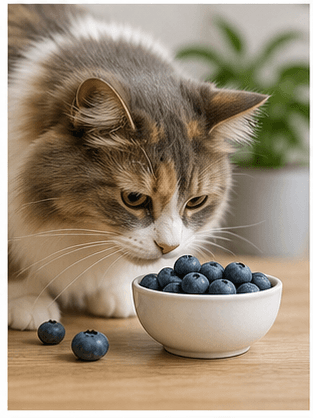
Curious cat sniffing a few blueberries in a small dish
Blueberries can be safe for many cats in tiny portions, but they should never replace complete cat food.
Educational guide only. This article does not replace a veterinary exam, diagnosis, or emergency care.

By PawBiotics Team

Cat Nutrition & Wellness | 8 min read

You’re snacking on blueberries. Your cat is watching. You wonder: is this okay to share?

It’s a small moment — but it points to a bigger question every cat owner eventually asks. Which human foods are actually safe? Which ones do more harm than good? And does any of it even matter when your cat is already eating commercial food?

The answers might surprise you. Let’s go through them properly.

Why What Your Cat Eats Outside Their Bowl Actually Matters

Cats are obligate carnivores. That means their bodies are built to run primarily on animal protein. But that doesn’t mean every non-meat food is off the table — and it doesn’t mean every “natural” food is harmless either.

The real issue is that most cat owners make food decisions based on what feels right, not what’s actually backed by how feline biology works. A food that’s harmless for you can trigger serious problems for a cat. And some foods that seem odd to give a cat can genuinely support their health when offered correctly.

Understanding the difference is where good pet care begins.

Blueberries and Your Cat: What’s Really Going On

Are blueberries safe for cats to eat? ✅ Safe

Yes — and they’re one of the few plant-based foods that offer real value to a cat’s body.

Blueberries contain a group of compounds called polyphenols, which act as antioxidants. In a cat’s body, antioxidants work to neutralize cellular damage that naturally accumulates over time — especially in older cats.

Food

Blueberries

Safety status

✅ Safe

Best use

2–3 plain washed blueberries, 2–3 times per week.

Food

Cooked eggs

Safety status

✅ Safe cooked only

Best use

Plain scrambled, boiled, or poached egg in small portions.

Food

Peanut butter

Safety status

⚠️ Use caution

Best use

Generally not useful for cats; avoid xylitol and sticky, sweetened products.

Food

Coconut oil

Safety status

⚠️ Small amounts only

Best use

Only tiny amounts if tolerated; watch stool, weight, and vomiting.

Food

Danger-list foods

Safety status

Never safe

Best use

Onion, garlic, grapes, raisins, chocolate, xylitol, alcohol, caffeine, and regular raw fish.

What antioxidants actually do inside your cat’s body

Checklist

  • Slow age-related cognitive decline — studies in aging cats point to oxidative stress as a contributor to memory and behavior changes
  • Support kidney tissue health — relevant for cats, who are statistically prone to chronic kidney issues in their senior years
  • Reduce inflammation — which plays a role in joint mobility, digestion, and immune function

Recommended Serving

The fiber content also helps regulate gut motility — meaning digestion moves at the right speed, reducing issues like constipation or loose stools.

Recommended Serving: 2–3 blueberries, 2–3 times per week. Wash thoroughly. Offer whole or sliced — never mashed into food, as some cats are put off by the texture change.

Don’t be surprised if your cat ignores them entirely. Cats lack sweet taste receptors, so blueberries hold no appeal on flavor alone. The ones who eat them are simply used to variety.

Serving question

How many?

Plain answer

2–3 blueberries.

Serving question

How often?

Plain answer

2–3 times per week.

Serving question

How to prepare?

Plain answer

Wash thoroughly. Offer whole or sliced.

Serving question

What to avoid?

Plain answer

Never mash into food if texture changes put your cat off. Avoid sweetened blueberry foods.

Cooked Eggs: One of the Most Underrated Cat Foods

Why eggs work so well for cats ✅ Safe (cooked only)

Of all the human foods on this list, cooked eggs have the strongest case for regular inclusion in a cat’s diet.

Eggs contain what nutritionists call “complete protein” — meaning all the essential amino acids a body needs are present in the right ratios. For cats specifically, two of these matter most:

Checklist

  • Taurine — cats cannot synthesize this on their own. Without enough taurine, they develop heart disease and vision problems over time. Eggs provide a natural taurine source.
  • Methionine — supports urinary tract health. Cats are vulnerable to urinary blockages and crystals; methionine helps maintain the right urinary pH.

Cooked vs. raw: this distinction is not optional

Raw eggs carry two real risks for cats. First, Salmonella — the same bacterial contamination risk that exists for humans. Second, raw egg whites contain a protein called avidin that blocks the absorption of biotin (vitamin B7). Over time, this creates a deficiency that affects skin, coat, and nerve function.

⚠️ Never feed raw eggs. The risks are real and cumulative. Scrambled, boiled, or poached — always fully cooked. No seasoning, no butter, no oil.

One small egg or about half a boiled egg per week is a reasonable starting point for most adult cats.

Peanut Butter: Popular Online, Less Useful in Reality

Can cats eat peanut butter? ⚠️ Use caution

Peanut butter became a pet-feeding trend largely because dogs seem to love it. But cats are not small dogs, and the nutritional logic doesn’t carry over.

Why peanut butter adds little value for cats

Checklist

  • Cats derive almost no nutritional benefit from plant-based proteins or fats
  • The calorie density is high relative to any nutrition it provides
  • The thick, sticky texture can cause difficulty swallowing — especially in older cats
  • Most brands contain added salt, sugar, or oils that cats simply don’t need

Peanut butter warning

⚠️ Critical warning: Many peanut butter brands — including “natural” ones — contain xylitol, an artificial sweetener. Xylitol is severely toxic to pets. Even small amounts can cause hypoglycemia and liver failure. Always read the full ingredient list.

Coconut Oil: Some Truth Behind the Hype

Is coconut oil beneficial for cats? ⚠️ Small amounts only

Coconut oil occupies an interesting middle ground. There is some legitimate science behind the claims — but the way most people use it is out of proportion with what the research actually supports.

What coconut oil can do for cats

Checklist

  • Medium-chain triglycerides (MCTs) in coconut oil are processed differently than other fats — they go directly to the liver rather than being stored
  • Lauric acid, one of the main MCTs, has mild antimicrobial properties
  • Topically, coconut oil can soothe dry, flaky skin patches
  • Some cats show modest coat quality improvements with very small oral amounts

Where people go wrong

The problems start when coconut oil is given in quantities that a cat’s digestive system isn’t built to handle. Too much fat — from any source — can cause vomiting and diarrhea, steady weight gain, and pancreatitis in cats with pre-existing sensitivity.

If you try it: Start with no more than ⅛ teaspoon once or twice a week. Watch your cat’s stool consistency and weight over 2–3 weeks before continuing.

Foods That Should Never Reach Your Cat — Ever

No amount of these is safe. There is no “a little bit is fine” threshold.

Never-feed item

Onions & Garlic

Why it matters

Destroy red blood cells; toxic even in powder or cooked form.

Never-feed item

Grapes & Raisins

Why it matters

Can cause acute kidney failure; mechanism still not fully understood.

Never-feed item

Chocolate

Why it matters

Theobromine is toxic to all pets; dark chocolate is especially dangerous.

Never-feed item

Xylitol

Why it matters

Found in gum, candy, some nut butters; causes severe hypoglycemia.

Never-feed item

Raw fish (regularly)

Why it matters

Thiaminase enzyme destroys thiamine (B1), causing neurological damage over time.

Never-feed item

Alcohol & caffeine

Why it matters

Even trace amounts can cause heart arrhythmia and neurological symptoms.

Checklist

  • Onions & Garlic — destroy red blood cells; toxic even in powder or cooked form
  • Grapes & Raisins — can cause acute kidney failure; mechanism still not fully understood
  • Chocolate — theobromine is toxic to all pets; dark chocolate is especially dangerous
  • Xylitol — found in gum, candy, some nut butters; causes severe hypoglycemia
  • Raw fish (regularly) — thiaminase enzyme destroys thiamine (B1), causing neurological damage over time
  • Alcohol & caffeine — even trace amounts can cause heart arrhythmia and neurological symptoms

The Bottom Line

Cats are not complicated eaters — but they are specific ones. Their bodies evolved around a very particular kind of diet, and even small deviations in the wrong direction can compound into real health problems over time.

Blueberries? Fine in moderation — genuinely useful. Cooked eggs? Excellent. Peanut butter? Skip it for cats. Coconut oil? Only if you’re very measured about it. And a handful of common human foods remain completely off the table, no matter how “natural” they seem.

The best thing you can do for your cat is get curious about what they actually need — not just what seems harmless or what other pet owners are posting about.

Want a nutrition plan built around your cat’s actual needs? Explore the full library at PawBiotics.us — in-depth guides covering life-stage nutrition, supplement basics, and species-specific diet planning, all in plain language.

Frequently Asked Questions

Contact your veterinarian immediately, even if your cat seems fine. Some toxic reactions are delayed — symptoms of kidney damage from grapes, for example, may not appear for 24–48 hours. Don’t wait for visible signs. Note exactly what was eaten and approximately how much.

Treats of any kind — including healthy ones like blueberries — should make up no more than 10% of your cat’s daily calorie intake. For most cats, that’s 2–3 blueberries a few times per week, not daily. Offer them as an occasional supplement, not a regular addition to every meal.

Nothing at all. Cats are missing the taste receptor gene that detects sweetness, so blueberries have no flavor appeal for them. If your cat ignores them, they’re just behaving like a normal cat. You don’t need to force the issue.

Kittens under 12 months have very specific nutritional requirements and more sensitive digestive systems. Their diets should be primarily composed of high-quality kitten-formulated food. If you want to introduce human foods to a kitten, consult your vet first.

The term “human grade” refers to ingredient sourcing standards — it doesn’t automatically mean the formulation is nutritionally superior. What matters most is whether the food meets AAFCO nutritional standards for your cat’s life stage and has high-quality named protein sources as the primary ingredient.

Watch for these signs in the 24–48 hours after introducing something new: vomiting, diarrhea or unusually loose stools, excessive drooling, loss of appetite, or unusual lethargy. If you see more than one of these together, stop the new food and consult your vet.

Most cats eating a complete, balanced commercial diet do not need additional supplements. However, specific health conditions — kidney disease, joint issues, or poor coat condition — may benefit from targeted supplementation. Always discuss supplement choices with a vet rather than guessing.