🐾Pawbiotics

Cats

Hypoallergenic Cat Breeds: What They Are and Which Ones to Consider

Published 2026-05-0110 min read

Cat allergies affect roughly 10–20% of the global population. Yet millions of allergy sufferers still share their homes with cats. The reason: some cats cause fewer reactions than others. This guide explains the science, lists the lowest-allergen breeds, and gives you practical strategies to reduce reactions.

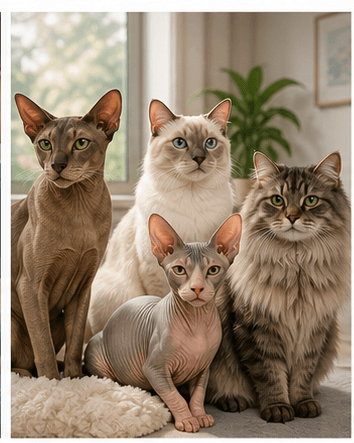
Group of different cat breeds often discussed for allergy-sensitive homes
No cat breed is completely hypoallergenic, but some cats may trigger fewer symptoms for certain people.
Educational guide only. This article does not replace a veterinary exam, diagnosis, or emergency care.

Are Any Cats Truly Hypoallergenic?

No. No cat breed is 100% hypoallergenic.

All cats produce the Fel d 1 protein — the primary cat allergen. It's found in cat saliva, skin glands, and urine. When cats groom, Fel d 1 coats their fur. It then dries and becomes airborne.

What varies between breeds is how much Fel d 1 a cat produces. Some breeds produce significantly less. That's what makes certain cats more tolerable for allergy sufferers.

Hair length is mostly irrelevant. A short-haired cat that produces lots of Fel d 1 will trigger more reactions than a long-haired cat that produces little of it.

What Causes Cat Allergies?

The immune system mistakes Fel d 1 as a threat and mounts an immune response. Symptoms include:

Fel d 1 is sticky and lightweight. It clings to surfaces, furniture, clothing, and stays airborne for hours. Even a cat-free room can test positive for cat allergen.

Checklist

  • Sneezing and runny nose
  • Itchy, watery eyes
  • Skin rash or hives after contact
  • Asthma symptoms in sensitive individuals

Best Hypoallergenic Cat Breeds

1. Siberian

The Siberian cat produces unusually low levels of Fel d 1 — studies suggest some individuals produce 2–4x less than the average cat.

This is surprising given the Siberian's thick, semi-long triple coat. Many severe cat allergy sufferers live successfully with Siberians.

They're large, affectionate, and dog-like in temperament.

2. Balinese

Often called the "long-haired Siamese," the Balinese produces lower Fel d 1 levels despite its silky, flowing coat.

They're vocal, social, and highly intelligent. Good choice for active households.

3. Sphynx

The Sphynx is hairless — but that's not why it's lower-allergen. Hairless cats still produce Fel d 1 through skin glands and saliva.

What changes is the absence of fur to carry and spread allergen around the home. Weekly bathing removes protein buildup from the skin.

Sphynx cats are warm, people-oriented, and mischievous.

4. Devon Rex

The Devon Rex has an unusually short, soft, wavy coat that sheds very little. Less shedding means less allergen distribution.

They're small, playful, and intensely bonded to their owners.

5. Cornish Rex

Similar to the Devon Rex, the Cornish Rex has a tight, curly, minimal undercoat. Very low shedding.

Active, social cats that love human interaction.

6. Russian Blue

The Russian Blue's dense, plush double coat traps allergens close to the body rather than releasing them freely into the air.

They also produce lower Fel d 1 levels on average. Calm, quiet, and gentle — a good choice for sensitive households.

7. Bengal

Bengals have a short, tight pelt-like coat that sheds minimally. Less grooming means less Fel d 1 spread.

Highly active and athletic. Needs significant stimulation and enrichment.

8. Oriental Shorthair

Very short, fine coat with minimal shedding. Produces less allergen than many other breeds.

Vocal, curious, and social — closely related to the Siamese.

Tips for Living With a Cat If You Have Allergies

Some allergy sufferers find that reactions diminish after 6–12 months of exposure as the immune system partially adapts.

Checklist

  • Choose a lower-Fel d 1 breed — Siberian is the top clinical pick
  • Keep cats out of the bedroom — 8 hours of allergen-free air matters
  • Use a HEPA air purifier in main living areas
  • Bathe your cat weekly — reduces surface allergen significantly
  • Vacuum with a HEPA filter vacuum 2–3x per week
  • Wash hands after every contact with the cat
  • Talk to your doctor about antihistamines or allergy immunotherapy

How to Test Before You Commit

Spend time with the specific cat (not just the breed) before adopting. Allergen production varies between individuals of the same breed.

Many breeders — especially Siberian breeders — will send a fur sample so you can test your reaction before visiting.

Spend at least 30–60 minutes with the cat in an enclosed space before making a decision.

❓ Frequently Asked Questions

Frequently Asked Questions

The Siberian is widely considered the top choice based on documented low Fel d 1 production. The Balinese, Devon Rex, and Russian Blue are also consistently recommended.

Most hypoallergenic breeds shed less than average cats — but they do shed. The difference is in allergen levels and coat behavior, not zero shedding.

Not entirely. Sphynx cats produce Fel d 1 through saliva and skin glands. But the lack of fur significantly reduces how much allergen spreads around the home.

Many do. Choosing a lower-allergen breed, combined with HEPA filtration, regular bathing, and bedroom boundaries, makes cat ownership manageable for many allergy sufferers.

Yes. Intact (unneutered) male cats produce the highest Fel d 1 levels. Females and neutered males produce significantly less. Spaying or neutering is recommended regardless of breed.